A Stay Ready Program from Coach C-Ray Knowles
Nobody Plans to Fall.But Everyone Can Prepare.
You've been told to be careful your whole life. But has anyone ever taught you what to do when you lose your balance?
Down to Earth: The Art of Falling is the field manual I wish I'd given my own mother. In plain language and simple steps, it shows you how to:
- Build steadier balance with slow, safe drills you can do next to your kitchen counter
- Get down to the floor, and back up, with control
- Know what your body should do in the last moment of a fall
- Have a plan for what to do if you ever can't get up
Instant digital access: just $4.95
30-day refund promise • Read on your phone, tablet or computer
From Coach C-Ray Knowles: 45+ years of martial arts, professional stunt work, and decades of teaching people how to land safely.
Looking for live classes? See upcoming classes ↓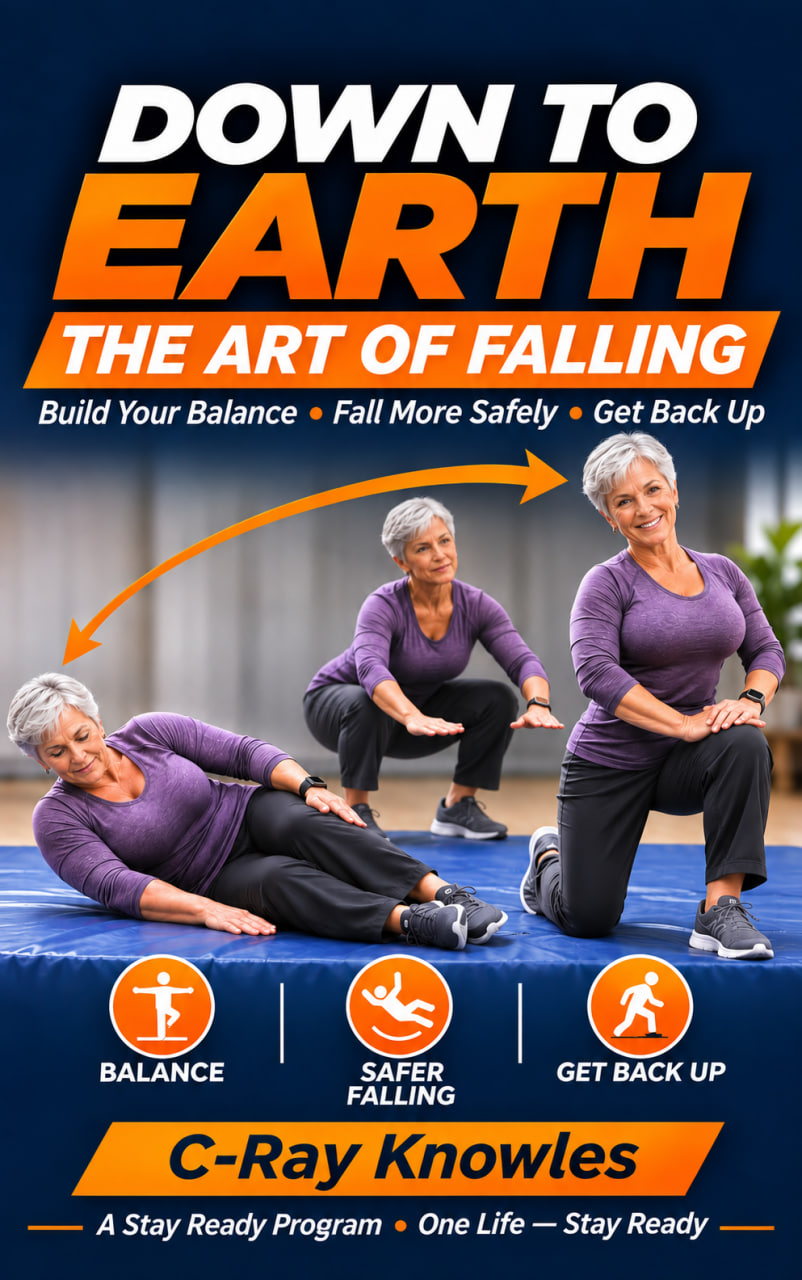
You Were Told Not to Fall. Nobody Taught You How.
Most of us got the same advice: "Be careful." "Watch your step." "Don't fall."
That's good advice. But it leaves out the most important part. What do you do when your foot catches a rug, a tile is wet, or someone bumps you in a crowded hallway?
For a lot of adults, the worry about falling starts to shrink their world. They walk less. They skip the garden. They stop getting down on the floor with the grandkids. But moving less can make muscles weaker and balance worse, and that makes the worry grow.
Does any of this sound familiar?
- You've had a fall or a close call, and now you think about every step.
- You hold onto furniture or walls when you walk around the house.
- Getting down on the floor feels risky, so you just don't do it anymore.
- You've wondered what you'd do if you fell and couldn't get up.
- You worry about a parent who lives alone.
If even one of these is true, this field manual was written for you.
Then there's the question nobody likes to ask: If I end up on the floor, can I get back up? Lying on the floor for a long time after a fall, what doctors call a "long lie," can cause serious problems of its own.
The answer isn't fear. It's preparation.
"The time to learn how to fall is before you fall."
Why I Teach This
The Mistake I'll Carry for the Rest of My Life

For more than 45 years, I've practiced martial arts. For decades, I taught martial artists, stunt performers, and law enforcement officers how to fall, roll, and hit the ground without getting hurt.
But I made a mistake I'll carry for the rest of my life. I never taught my own mother.
As she grew older, she lost some of her balance and strength. One day, she fell at home and broke her hip. Watching her go through that pain and lose her independence broke my heart.
I can't say that teaching her would have prevented her injury. But I can't help wondering if it might have made a difference. And that thought drives me today.
I don't want another son or daughter to look back and wish they'd given someone they love the chance to learn these skills before they needed them.
That's why I created the Down to Earth Method.
Warren's Story
My good friend Warren, who later became my brother-in-law, trained in my jujitsu class. We spent hours on basic breakfalls: lowering the body, tucking the chin, and meeting the ground the right way.
Years later, Warren lost his balance and fell off the top of a tractor-trailer onto hard ground. He called me afterward. He told me that as he started to fall, his body just did the breakfall. He hit the ground, rolled, and walked away unhurt.
He wasn't telling me about a move he'd planned. He was telling me his body reacted to something we'd practiced over and over. That's the value of training a response before you ever need it.
Warren's story is one personal account. A fall like his is very dangerous, and his outcome was fortunate. It isn't a promise of what will happen to anyone else.
The Three Pillars of the Down to Earth Method
Most fall programs focus only on not falling. Down to Earth covers the whole picture: before, during, and after.
Build Your Balance
Stay steady on your feet.
Strengthen your legs and ankles, practice slow weight shifts near a sturdy support, and teach your body to recover when you lose your footing.
Your benefit: Walk, reach and turn with more confidence.
Fall More Safely
Know what to do in the last moment.
Learn the Three Body Rules (tuck your chin, blow the air out, and land beside your spine, not on it), and give your hands a job instead of reaching out with a stiff arm. You learn it step by step, starting seated, and all falling practice is supervised.
Your benefit: A trained response instead of panic.
Get Back Up
Never feel stuck on the floor.
Learn a supported, step-by-step way to get down to the floor and back up using sturdy furniture, plus a plan for what to do if you can't get up.
Your benefit: Confidence that the floor is not a trap.
Can Adults Really Learn This? Research Says Yes.
Falling is a skill, and skills can be learned at any age.
In a study from Sweden, 200 older adults, about 72 years old on average, took a judo-based class once a week for 12 weeks. They got better at falling forward, backward and sideways, and their confidence went up. Twenty months later, they were still better at forward and sideways falls than the people who didn't take the class.
Source: Arkkukangas et al., International Journal of Environmental Research and Public Health, 2022. Research on falling skills is still growing, and no study has yet shown that falling practice lowers real-world injuries. That's why we train carefully, step by step, with supervision.
What's Inside the Field Manual
Down to Earth: The Art of Falling is a practical field manual. Plain words, clear steps, and things you can use the same day.
Here's some of what you'll discover:
- The one question to answer before you train, and why it matters more than any exercise
- A simple Starting-Point Checklist that shows where you're strong and where to begin, with no risky tests
- Why a yoga mat is the wrong surface for learning to fall, and what to use instead
- Coach C-Ray's neck-to-toes warm-up, with step-by-step pictures
- Why doing well on a balance test isn't the same as handling a real trip
- The 2-second pause that makes getting down to the floor calmer and more controlled
- How to get up from the floor using a sturdy chair, and the 'backward chaining' method physical therapists use to make it easier to learn
- The Three Body Rules that protect your head and spine
- Why 'hands are like kids,' and the three jobs that keep them from reaching out with a stiff arm
- What to do if you start to fall backward, the worst-case fall, and how we train to turn it into a side fall when you can
- The first three things to do after any fall: Pause, Check, Plan
- The 'long lie': what it is, why it's dangerous, and how to plan for help before you ever need it
Plus 7 fill-in worksheets and 3 field cards you can print and keep on your fridge or in your wallet.
Worksheets, Checklists and Field Cards Included
- My Starting-Point Checklist
- Practice Safety Checklist
- My Getting-Up Plan
- My Falling Practice Level
- My Fall Report
- My Weekly Practice Log
- My Stay Ready Commitment
- Field Cards: The Art of Falling • If I Fall • Home Practice Rules
Why Only $4.95?
Because I never want price to be the reason someone doesn't learn this. I waited too long with my own mother. I'd rather this book get into as many hands as possible: yours, your parents', your friends'.
My 30-Day Promise
Read it. Try the worksheets. If you don't feel it was worth $4.95, email support@crayworks.com within 30 days for a full refund.
Everything above, for just $4.95.
Get My Field Manual — Just $4.95
Meet Coach C-Ray Knowles
Coach C-Ray Knowles has spent more than 45 years practicing martial arts and more than 38 years teaching people how to move, stay strong and protect themselves.
His background includes professional stunt work, where landing safely is part of the job every day. He has also taught defensive tactics, trained law enforcement officers, and founded PhenixFitt, a training program focused on real-world strength and mobility for everyday life.
Today, he brings those same skills to everyday adults in a way that's safe, gradual and built for real bodies.
"I don't measure success by how high someone can fall from. I measure it by how well they understand and control the movement."
Worried About Mom or Dad?
Maybe you've noticed them holding onto the wall. Maybe they've already had a close call. It's hard to bring up without sounding like you're telling them they're getting old.
This field manual gives you an easy way to start that conversation, and a plan you can work on together. Get them a copy, read it with them, and fill out the checklists side by side.
Reading About Falling Is One Thing. Learning the Skills With a Coach Is Another.
The field manual gives you the knowledge. The Down to Earth class gives you a coach who watches how you move, corrects your form, and helps you progress safely.
And no, we don't start by throwing anybody on the ground.
Six instructor-led classes cover:
- Mobility and movement preparation
- Balance and body awareness
- Getting down to and up from the floor
- Forward falling skills
- Sideways falling skills
- Backward falling skills, including turning a backward fall into a side fall when you can
How it works:
- Everyone starts at the right level. We meet you where you are.
- We begin seated on a raised mat that's about the height of a chair.
- You move up step by step, when you show comfort, control and ability, and your instructor agrees.
- All falling and impact practice is supervised, on proper mats.
- Your level is your level. Not everyone needs to reach standing falls to benefit.
Keep going after the six classes: Down to Earth Level 1 and Level 2 classes keep building your falling, balance and getting-up skills with supervision. PhenixFitt strength and fitness classes build the muscle you need for everyday life. Mobility Classes help keep your joints moving and your body aware.
Upcoming Down to Earth Classes
Don't Miss Our Next Down to Earth Class!
Want to be first to know when the next class opens? Join our priority notification list, and we'll let you know when registration begins.
Haven't read the field manual yet? It's the best place to start, and it's just $4.95.
Frequently Asked Questions
The Time to Learn How to Fall Is Before You Fall.
I can't go back and teach my mother. But you can start today, for yourself or for someone you love.
You don't train to prove how tough you are. You train so you can keep doing what you love: playing with your grandkids, working in your garden, walking your neighborhood, and living on your own terms.
One Life — Stay Ready.
P.S. It's $4.95, it's covered by my 30-day promise, and you can start reading in the next five minutes. The best time to learn this is before you need it. — Coach C-Ray